Donate 1300 781 500
[email protected]

Melbourne Peer Support Hub
Level 8, 255 Bourke Street, Melbourne
Open 10am – 5pm Mon, Wed, Thurs
(closed public holidays)

Skip to main content
[email protected]

Melbourne Peer Support Hub
Level 8, 255 Bourke Street, Melbourne
Open 10am – 5pm Mon, Wed, Thurs
(closed public holidays)

Three reasons to become a Peer Support Volunteer

Our previous post Five reasons to call a Peer Support Volunteer  highlighted the importance and benefits of talking to someone who understands your diagnosis but there are also a number of reasons to become a Peer Support Volunteer too! Places for our 2021 volunteer intake are open now.  Read below for insights into volunteering and how to apply.


1. Using your experience for the greater good

Although every woman’s cancer experience is different, you’ve been through the treatments, worries and ongoing appointments. You know what to expect which means you are in a unique position to lend a reassuring, sympathetic ear to women who are facing these situations.


2. Being part of a team of women who understand your life experience

Our Peer Support Volunteers connect with each other during training, when coming into the Resource Centre or at our events. They’ve told us that they enjoy the friendships they’ve made with other women who get what they’ve been through.


3. Shifting the focus on your cancer diagnosis

Helping others can provide opportunities to learn and discover new things about ourselves. We can realise how far we have come, how strong we are and how much we have to offer.


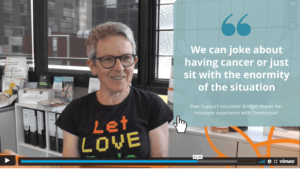
In this vimeo video Peer Support Volunteer Bridget shares her Counterpart volunteer experience. 

Have you ever considered volunteering? We are currently recruiting! 

If you would like to know more about how you can join our Peer support Volunteer team visit the volunteer section of our website. Here you will find details on what is involved as well as a link to register for our online information session and an application form.  Applications close 7 June 2021.


Five reasons to call a Peer Support Volunteer

It can be daunting to pick up the phone and talk to a stranger, but if you have experienced breast or a gynaecological cancer, calling Counterpart can be rewarding.


1. Sometimes you need someone who understands

Everyone’s experience is different but talking to someone else who has been through a cancer diagnosis can help. You don’t need to explain or justify your feelings to a Counterpart Peer Support Volunteer. They don’t provide medical advice or counselling, but they’ve been there and they know there is no right or wrong way to be . Counterpart does not provide medical or financial advice or counselling.


2. They aren’t your family or friends

So many women feel the need to put on a brave face to their loved ones. This is especially likely for women who have caring responsibilities for others, whether it is children, ageing parents or another relative. You can speak freely to a Counterpart Peer Support Volunteer because they don’t need anything from you. All they are here for is to listen and give you support.


3. Counterpart’s services are confidential

You don’t need to worry about your privacy when you talk to a Counterpart Volunteer. Counterpart takes privacy very seriously and will never share your health information (unless we are forced to by law, but that’s very unlikely to ever happen). All our service user records are stored with the highest available protection and our volunteers understand the importance of maintaining confidentiality.


4. Peer Support Volunteers are extensively trained to support you

Becoming a Counterpart Peer Support Volunteer takes over 40 hours of training. The volunteers have a lot of experience in providing peer support and, if you have a difficult scenario to talk through, they can also additional support from a staff member if necessary. No matter what, the main aim is getting you the support or information you want.


5. Talking about cancer can be fun

That sounds strange doesn’t it? If you don’t want to have a heavy discussion right now, you might be pleasantly surprised to know that sometimes conversations with Peer Support Volunteers end in laughter. Sometimes sharing your worries can be the best way to lift your mood. Our volunteers can show you that there can be a light at the end of the tunnel.


Arrange to speak to a Counterpart Peer Support Volunteer

Call 1300 781 500

Make an online request

Email: [email protected]

Have you ever considered volunteering? We are currently recruiting! 

See our post Three reasons to become a Peer Support Volunteer  for insights.

Applications are now open to join our team as a Peer Support Volunteer. If you would like information or to attend our online information session please visit the volunteer section of our website.  Applications close 7 June 2021.


International Women’s Day 2021 – Choose to Challenge.

March 8 is International Women’s Day. The theme for this year is Choose to Challenge. There are still many male dominated industries/places of work and science is no exception. As an organisation that supports women through their cancer experience, Counterpart would like to take this opportunity to say a massive thank you to women in science and in particular cancer research.

We appreciate all work carried out in this area regardless of gender, but we recognise that it can be difficult for women to make their mark in this industry. According to the Department of Industry, Science, Energy and Resources women in STEMM (Science, Technology, Engineering and Mathematics) continue to be paid less than men in these industries and only 14.5% of STEMM professors are women. For more stats like this visit women in stem at a glance.

The women mentioned below are a wonderful representation of what is possible when women do enter the field of science and the positive impacts women can have in cancer research.


Dharmica Mistry

Dharmica Mistry is a Microbiologist and co-founder of Breast Cancer Associated Lipids (BCAL) Diagnostics. Whilst researching the relationship between breast cancer and hair, Dharmica uncovered that certain lipids were linked to breast cancer. The aim was to then separate and identify these lipids in a blood test as an affordable, non-invasive and accurate way of detecting breast cancer. The outcome of this work is very promising as the Breast Cancer Associated Lipids tests have an accuracy of 90%, a rate that is higher than other methods currently available.

Read more –  Global Shakers – Dharmica Mistry.


Elizabeth Blackburn

In 2009 Tasmanian scientist Elizabeth Blackburn was the first Australian woman to win a Nobel Prize for Physiology or Medicine.  Her work in research began long before though. In 1984, Elizabeth and co-scientist Carol Greider discovered the telomerase, the protective cap at the ends of eukaryotic chromosomes that prevent it from damage— a discovery that has significantly impacted cancer research.

Read more –  Nobel Prize – women who changed science – Elizabeth Blackburn


A/Professor Misty Jenkins

A/Professor Misty Jenkins is the laboratory head in the Immunology department at the Walter Eliza Hall Institute. She has received 15 awards for her work including the L’Oreal for Women in Science Fellowship for Australia (2013).  A/Professor Jenkins has a history in cytotoxic lymphocyte biology and has spent the past ten years investigating how killer lymphocytes acquire the ability to kill cancer cells.

Read more –  Associate Professor Misty Jenkins | WEHI


Professor Christina Mitchell

Professor Christina Mitchell trained as a physician scientist specialising in clinical haematology. She has published over 100 papers and received many awards including an Order of Australia for distinguished service to medicine in the field of haematology, to medical education and research, and to academic leadership in 2019.

Professor Michell’s research area is the mechanisms of inhibition of PI3K signalling in cancer and developmental disease. Her group was among the first to locate, purify and clone important enzymes in cancer.

Read more – Christina Mitchell – Projects — Monash University


Dr Leonie Walsh

Dr Walsh has accumulated more than 25 years of technology leadership experience and was Victoria’s first Lead Scientist (2013-2016). She has been involved in blood cancer research and is currently the Vice President of the Fight Cancer Foundation.

As a strong advocate for women in STEMM, Dr Walsh was recently named the inaugural Ambassador for Women in STEMM Australia.

Read more – Dr Leonie Walsh | Swinburne and Ambassadors – Women in STEMM Australia (womeninscienceaust.org).


For more information on women in STEMM in Australia visit Women in STEMM Australia – – connecting women in STEMM Down Under (womeninscienceaust.org)

 

February is Ovarian Cancer Awareness Month

What is ovarian cancer?

Ovarian cancer is type of gynaecological cancer that develops when abnormal cells multiply forming malignant tumour/s in one or both ovaries. It is the eight most common cancer among Australian women. For an overview of what ovarian cancer is from symptoms to diagnosis and treatment visit this overview from Cancer Council. For further stats on how women in Australia are affected by ovarian cancer visit Ovarian cancer statistics in Australia | Cancer Australia.

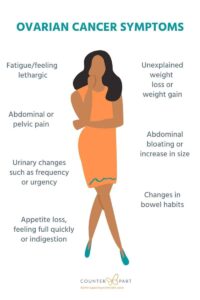
Information source: Cancer Australia – ovarian cancer symptoms.


The image above shows the most common symptoms of ovarian cancer.
Other symptoms can include:

  • Lower back pain
  • Bleeding after menopause or in-between periods
  • Pain during sex or bleeding after

Further resources relating to causes and risks, detection and treatment can be found on the following websites:

Ovarian Cancer Australia                                                 The Royal Women’s Hospital

Cancer council – care guides                                           Cancer Australia


Have you been diagnosed? Contact us for support.

If you have been diagnosed with ovarian cancer Counterpart Peer Support Volunteers are here to help. Our highly trained and professional Peer Support Volunteers are women who have experienced breast or a gynaecological cancer diagnosis and provide emotional support, understanding, hope and comfort. Contact us to access this support.

In this short video below, Counterpart Peer Support Volunteer, May, a woman with experience of ovarian cancer explains why volunteering at Counterpart is so important to her.


Looking for up-to-date information on ovarian cancer after your diagnosis?

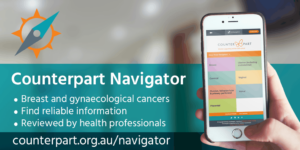
Receiving a diagnosis can be a confusing and daunting time. If you are affected by ovarian cancer you may like to consult the Counterpart Navigator for up-to-date information on diagnosis, what to expect when having treatment, life after treatment and if cancer won’t go away. The Counterpart Navigator is regularly reviewed by health professionals and is available online or via the free app.

For more information see the web version here Counterpart Navigators – ovarian cancer.

Or download the App:

Navigator imageGoogle Play icon


AppStore logo


Counterpart events for February to April 2021

Our first What’s On and Making Connections programs for 2021 are now live.  The Making Connections program includes a special day of info sessions and workshops for women living with a metastatic/advanced breast or gynaecological cancer. Other sessions include a Dance flow workshop, Introduction to self-compassion session, Advance care planning info session and a Lymphoedema webinar. Our events remain online at the moment and our peer support services continue to be provided over the phone or via email also. To view all free events available visit our events page.

Please note that we have updated our booking system. All bookings are now taking place via Eventbrite to streamline our processes. By clicking on the registration link featured on each event on our website you will be directed straight to that event listing on Eventbrite.

Connecting online

We have been running some of our information sessions as webinars since 2014, but during the COVID-19 pandemic, all of our events are being moved online. Although many miss face to face connections, joining an online event can be a great way to stay connected or to try something new.

Susan has attended a number of our events and has kindly shared her experiences.

Wellbeing activities in online workshops

I have found the Counterpart workshops to be a wonderful way to keep connected in these uncertain times. The activities that Counterpart offer have been very enjoyable, especially the Meditation workshop.

I participated in a belly dancing online workshop recently, and had a great time. This is not something I would have participated in if it wasn’t available online. Having the ability to do these classes at home has made me feel more relaxed and I have experienced an increase in interaction between myself, the teacher, and the others participating in the class. It is absolutely lovely to chat with the other ladies.

The Feldenkrais workshop was a lovely way to become more aware of my body. The teacher was clear in her instructions. This workshop left me feeling very relaxed and it was wonderful to do this class in the comfort of my own home. Not having to travel a few hours to and from the Counterpart Resource Centre eliminates so much stress, making all these classes even more enjoyable to participate in.

Getting information from webinars

I also enjoy watching the webinars live, however, having access to them at a later date can be more practical sometimes. This is excellent as I am not always available when the webinar’s occur. This makes me so grateful I have this option. I don’t have to miss out. If I have any questions they can be submitted beforehand to be answered during the webinar.

The presenters are always very informative, generally including visual slides which I enjoy. They answer the questions thoughtfully and I am often able to personally relate to the questions that are asked from my own experience.

I enjoy scrolling through the recorded webinars and choose ones that I feel like watching. ‘Shrink your worries’ was a really enjoyable webinar which I watched three months after it was recorded. I would highly recommend Counterpart for online workshops and webinars.

Visit our Upcoming events page for all Counterpart’s upcoming webinars and online workshops.

(Photo by Tatiana Syrikova from Pexels).

Coronavirus update – we are continuing to support women with breast or a gynaecological cancer

Women’s Health Victoria recognises we are in unprecedented times and now more than ever it is important that we continue our work supporting women and advocating for gender equality.

Like everyone, we are watching the situation with the coronavirus (COVID-19) carefully. You can read the latest recommendations from the Victorian Department of Health and Human Services here.

Our main priority is looking after the health and wellbeing of everyone who uses our service, our volunteers and staff.

  • Until further notice, all of community-based events are postponed or suspended including our Feel Good gentle exercise program.
  • We will continue to provide webinars and online workshops.  See our upcoming sessions page for more information.

We are here if you need us and will continue to provide peer support on Monday, Wednesdays and Thursdays between 10am and 2pm.

Call 1300 781 500, email [email protected] or request a call from a Peer Support Volunteer.


Interpreter symbolFor translated information, updates and advice about the outbreak of coronavirus (COVID-19) for people from culturally and linguistically diverse backgrounds, health professionals and industry, visit the Victorian Government website.


Further information about the virus is available here:

When isolation and cancer coincide

isolation and cancer - photo of a telephone

Many women affected by cancer say they don’t want to burden their loved ones with their thoughts or worries about their cancer. With so many people understandably concerned about the COVID-19 pandemic and its ongoing impact, you might be feeling even more pressure to put on a brave face. This can leave you feeling even more isolated.

May is one of the Counterpart Peer Support Volunteers who is working from home at this time making calls to women experiencing breast or a gynaecological cancer. She shared her thoughts on how she is able to help the women she talks to.

‘Peer support means using my experience to help someone in a similar situation. I can walk alongside someone who has experienced cancer to comfort and help them as I have walked along a similar path. It might be their first time diagnosed with cancer or they may have been on the path before and just want someone to listen to their story.

Right now, peer support is especially important, as many of us are feeling the effects of isolation. I think Counterpart Peer Support Volunteers can help because we know what it is like to have cancer, and we can give women a space to talk through their feelings or worries.

Feelings of uncertainty and a sense of being even less in control may be magnified at this time.

Someone undergoing treatment may feel concerned about infection with their already low immunity. Telehealth is assisting women in receiving medical care, but some have found they miss the extra emotional support and comfort they get from a face-to-face appointment.

Separation from support systems due to social isolation measures may be distressing for some who cherish every moment they have with their loved ones. Their regular care may also be disrupted at this time. With virtual meetings, the healing power of touch is unfortunately restricted.

The women I speak with as a Peer Support Volunteer can see that we survived through the tough times and ‘live to tell the tale’. It can give them hope when they see that we are living well after the experience.

Many also want to share the war stories as well as the good news stories to really feel that they are not alone.’

Speak with a Peer Support Volunteer

Phone 1300 781 500 and leave a message
Email [email protected]
Request a call online

Some free guided meditations to help you look after yourself

If you are stuck at home because of the coronavirus precautions, it may be a good time to give guided meditation a try.

During stressful times, following a guided meditation can be helpful. Meditation is a practice that can help you clear your mind. It can also calm your emotions and improve your wellbeing. Many women find this helpful, especially when worried or anxious.

Our friend Matt Young, the director of the Melbourne Meditation Centre, has shared some short guided meditations with us.

Matt has presented many wonderful meditation sessions at Counterpart/BreaCan over the years. We appreciate his clear, kind and no-fuss approach to meditation.

You can visit the Melbourne Meditation Centre‘s website for more information, meditation CDs and online meditation courses.

Matt is also presenting our online workshop on meditation on 4 May.

Three Senses Meditation (for immediate anxiety relief)

Calming Breath

At Home Within Yourself

Cancer Survivorship Care Consensus Statement

In 2019, community support organisations met to discuss work around cancer survivorship. One of the key recommendations from these forums was to produce a consensus statement. This was facilitated by the Australian Cancer Survivorship Centre (ACSC).

Counterpart, as a service of Women’s Health Victoria, is proud to be one of the 19 community support organisations to have endorsed this statement.

The statement outlines the important role of community support organisations in supporting people who have been diagnosed with cancer. It also identifies the different ways community support organisations help people affected by cancer.

Download the Community Support Organisations’ Cancer Survivorship Care Consensus Statement (PDF 1MB).

Counterpart is a service of
Our other services and initiatives